Ignorer et passer au contenu


If your car feels wobbly on bumpy roads or your tires wear unevenly, the culprit is likely your control arms—critical suspension parts that keep wheels aligned and your ride stable. But not all control arms are the same: upper and lower control arms play distinct roles, and understanding their differences can save you from costly repairs (like unexpected control arm replacement costs) and keep your car handling like new.
What Are Upper and Lower Control Arms?
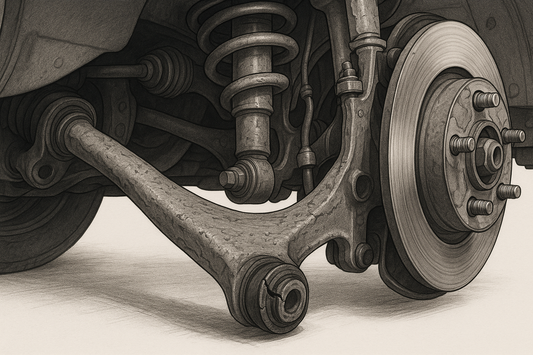
Control arms (also called “wishbones” or “A-arms”) are Y-shaped suspension components that connect the wheel hub to the vehicle’s frame. They’re the backbone of your suspension system, allowing wheels to move up/down over bumps while keeping them aligned with the road.
- Upper control arm: Mounted higher on the frame, it connects to the top of the wheel hub.
- Lower control arm: Attached lower on the frame, linking to the bottom of the wheel hub.
Core Functions: Upper vs. Lower Control Arms
While both control arms work together to stabilize your ride, their roles diverge sharply:
Lower Control Arm: The Heavyweight Workhorse
The lower control arm bears most of the suspension’s load—up to 70% of the vehicle’s weight during acceleration, braking, or hitting potholes. Its key jobs:
- Weight Distribution: Absorbs impacts from road debris, potholes, or speed bumps.
- Tire Contact: Keeps the tire pressed firmly to the road, ensuring traction and reducing skidding.
- Lateral Stability: Prevents wheels from shifting sideways during turns, keeping steering responsive.
Upper Control Arm: The Alignment Specialist
The upper control arm is lighter-duty but equally critical for precision:
- Camber Adjustment: Controls the wheel’s tilt (positive/negative camber), preventing uneven tire wear.
- Vertical Movement: Works with the lower arm to guide wheels up/down smoothly over rough terrain.
- Steering Precision: Fine-tunes wheel angles during turns, keeping the car stable.

Key Differences: Upper vs. Lower Control Arms
| Feature | Upper Control Arm | Lower Control Arm |
|---|---|---|
| Weight Bearing | Minimal (guides movement) | Heavy (70%+ of suspension load) |
| Wear Rate | Slower (less exposure to road debris) | Faster (closer to the ground, absorbs impacts) |
| Replacement Cost | $50–$150 (parts only) | $80–$200 (parts only, due to sturdier design) |
| Vehicle Compatibility | Required for double-wishbone suspensions | Found in all modern cars (strut or wishbone systems) |
Why Lower Control Arms Wear Faster (and How to Spot It)
Lower control arms take the brunt of road abuse—mud, salt, and potholes wear their bushings and ball joints faster. Watch for these red flags:
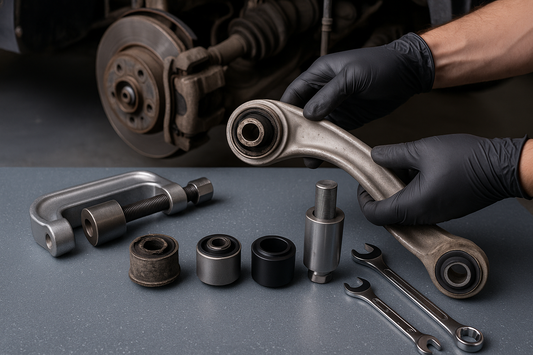
- Clunking Noises: A “thud” over bumps means worn bushings (rubber cushions) are failing.
- Uneven Tire Wear: Worn lower arms misalign wheels, causing tires to scrub sideways.
- Loose Steering: The car drifts or feels “floaty” at highway speeds.
Pro Tip: Lower control arm issues often lead to costly control arm replacement if ignored—replace bushings or ball joints early to avoid full arm replacement.
Control Arm Replacement Costs: Upper vs. Lower
Replacing control arms depends on your car’s make and whether you choose OEM or aftermarket parts:
-
Upper Control Arm:
- Parts: $50–$150 (OEM) vs. $30–$100 (aftermarket).
- Labor: $100–$200 (1–2 hours of work).
-
Lower Control Arm:
- Parts: $80–$200 (OEM) vs. $50–$150 (aftermarket).
- Labor: $150–$300 (2–3 hours, harder to access).
Example: A Honda Civic’s lower control arm replacement (aftermarket part + labor) averages $250–$400.
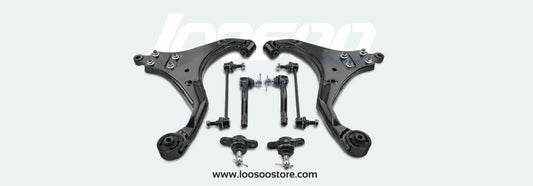
Brands like Loosoo offer corrosion-resistant control arms (upper/lower) with reinforced bushings—they last 20% longer than generic parts, saving you from frequent replacements.

Maintenance Tips to Extend Their Life
- Inspect Annually: Check bushings for cracks or tears (use a jack to lift the wheel and wiggle the control arm).
- Lubricate Ball Joints: Prevent seizing with grease (especially if you drive off-road).
- Avoid Potholes: Lower control arms take the hit—slow down on rough roads!
Final Take: Both Are Critical, But Lower Arms Need Extra Love
Upper and lower control arms work as a team: the upper fine-tunes alignment, while the lower absorbs the hard impacts. But since lower control arms wear faster and cost more to replace, prioritize their maintenance. By spotting issues early and choosing durable parts (like Loosoo’s reinforced control arms), you’ll keep your ride smooth and your wallet happy.